Posts

2016-02-24: Acquisition of Mementos and Their Content Is More Challenging Than Expected
Image
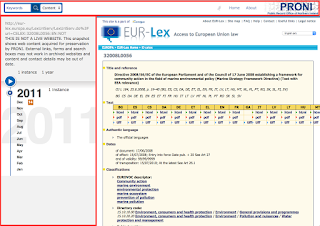
Recently, we conducted an experiment using mementos for almost 700,000 web pages from more than 20 web archives.  These web pages spanned much of the life of the web (1997-2012). Much has been written about acquiring and extracting text from live web pages, but we believe that this is an unparalleled attempted to acquire and extract text from mementos themselves. Our experiment is also distinct from AlNoamany's work  or  Andy Jackson's work , because we are trying to acquire and extract text from mementos across many web archives, rather than just one. We initially expected the acquisition and text extraction of mementos to be a relatively simple exercise, but quickly discovered that the idiosyncrasies between web archives made these operations much more complex.  We document our findings in a technical report entitled:  " Rules of Acquisition for Mementos and Their Content ". Our technical report briefly covers the following key points: Special technique...

2016-01-28: January 2016 Federal Cloud Computing Summit

Image
As I have mentioned previously , I am the MITRE chair of the Federal Cloud Computing summit . The Summits are designed to allow representatives from government agencies that would not necessarily cross paths to collaborate and learn from one another about the best practices, challenges, and recommendations for adopting emerging technologies in the federal government. The MITRE- ATARC Collaboration Symposium is a working group-style session in which academics, representatives from industry, government, and FFRDC representatives discuss potential solutions and ways-forward for the top challenges of emerging technology adoption in government. MITRE helps select the challenge areas by polling government practitioners on their top challenges, and the participants break into groups to discuss each challenge area. The Collaboration Symposium allows this heterogeneous group of cloud practitioners to collaborate across all levels, from the end users to researchers to pract...

2016-01-02: Review of WS-DL's 2015

Image
. @WebSciDL reunion at #jcdl2015 - 4 phd alumni, 3 phd students, 2 profs! pic.twitter.com/kA8CUYtZCW — Michael L. Nelson (@phonedude_mln) June 23, 2015 The Web Science and Digital Libraries Research Group had a terrific 2015, marked by four new student members, one Ph.D. defense, and two large research grants.  In many ways it was even better than 2014 and 2013 . We had fewer students graduate or advance their status this year, but last year was unusually productive.  We did add four new students, as well as graduate a PhD student, an MS student, and had two other students advance their status: Hany SalahEldeen defended his Ph.D. on May 5, 2015 and then took a cross country motorcycle trip on his way to join Microsoft in Redmond, Washington.   Shawn Jones defended his M.S. thesis on March 23, 2015 and then joined LANL as a Graduate Research Assistant in the fall of 2015.  Shawn will continue his PhD work while @ LANL, working with Herbe...

2015-12-24: CNI Fall 2015 Membership Meeting Trip Report

Image
The CNI Fall 2015 Membership Meeting was held in Washington, D.C., December 14-15, 2015.  Like all CNI meetings, the Fall 2015 meeting was excellent and contained many high quality presentations.  Unfortunately, the members' project briefings ran simultaneously, with 7 or 8 different presentations overlapping at any given time.  As a result I missed a great deal.  Cliff Lynch kicked off the meeting with reflections about public access to federally funded research (e.g., CRS R42983 ), interoperability (e.g., OAI-ORE , ORCIDs , IIIF ), linked data (e.g., Wikipedia notability guidelines for biographies ),  privacy & surveillance (e.g., eavesdropping Barbies , Ashley Madison data breach , RFC 7624 ), and understanding the personalization algorithms that go into presenting (and thus archiving) the view of the web that you experience (e.g., our 2013 D-Lib Magazine article about mobile vs. desktop & GeoIP ), and much more.  I'm hesitant to try to fur...

2015-12-08: Evaluating the Temporal Coherence of Composite Mementos

Image
When an archived web page is viewed using the Wayback Machine, the archival datetime is easy to determine from the URI and the Wayback Machine's display.  The archival datetime of embedded resources (images, CSS, etc.) is another story.  And what stories their archival datetimes can tell.  These stories are the topic of my recent research and Hypertext 2015 publication.  This post introduces composite mementos, the evaluation of their temporal (in-)coherence, provides an overview of my research results.   What is a composite memento?   A Memento is an archived copy of web resource ( RFC 7089 )  The datetime when the copy was archived is called its Memento-Datetime .  A composite memento is a root resource such as an HTML web page and all of the embedded resources (images, CSS, etc.) required for a complete presentation.  Composite mementos can be thought of as a tree structure.  The root resource embeds other resources, which...

2015-11-28: Two WS-DL Classes Offered for Spring 2016

Image
Two WS-DL classes are offered for Spring 2016: CS 725/825 - Information Visualization , Dr. Weigle CS 432/532 - Introduction to Web Science , Dr. Nelson Information Visualization is being offered both online (CRNs 29183 (HR), 29184 (VA), 29185 (US)) and on-campus (CRN 25511).  Web Science is being offered for the first time with the 432/532 numbers (CRNs 27556 and 27557, respectively), but the class will be similar to the Fall 2014 offering as 495/595 .  --Michael

2015-11-24 Twitter Follower Analysis of Virginia University Alumni Associations

Image
The primary goal of any alumni association is to maintain and strengthen the ties between its alumni, the community, and the mission of the university. With social media, it's easier than ever to connect with current and former graduates on Facebook , Instagram or Twitter with a simple invitation to "like us" or "follow me." Considering just one of these social platforms, we recently analyzed the Twitter networks of twenty-three (23) Virginia colleges and universities to determine what, if any, social characteristics were shared among the institutions and whether we could gain any insight by examining the public profiles of their respective followers. The colleges of interest, ranked by number of followers in Table 1, vary in size, mission, type of institution, admissions selectivity and perceived prestige. Each of the alumni associations has maintained a Twitter presence for an average of six (6) years. The oldest Twitter account belongs to Roanoke C...