Posts

Showing posts with the label chi2022

2023-08-30: Summary of "Supporting Accessible Data Visualization Through Audio Data Narratives"
Image
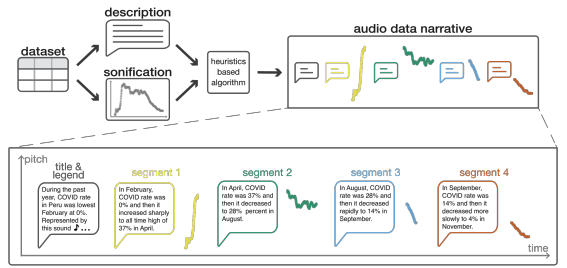
  Figure 1: A proposed heuristics-based approach to automatically generate a narrative given a time-series dataset (Figure 1 in Siu et al. ) The use of online data visualizations is becoming more crucial in informing the public and aiding decision-making. However, most guidelines and tools for creating these visualizations are centered around visuals, leaving little consideration for screen reader users who rely on non-visual methods to access data. As a result, there needs to be more exploration of alternative representations that cater to their needs. In the paper “ Supporting Accessible Data Visualization Through Audio Data Narratives, ”, published at CHI 2022 conference, Siu et al. introduced audio data narratives and accessible data representation for screen reader users that use image descriptions and sonification to provide direct, multimodal, and up-to-date access to data. These narratives employ image descriptions and sonification to offer direct, multimodal, and real-ti...
2022-11-28: Summary of "What makes web data tables accessible? Insights and a tool for rendering accessible tables for people with visual impairments"

Image
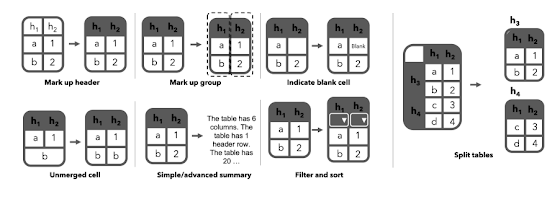
Figure 1: Based on the guidelines and the study, the authors built a browser plug-in to make the table more accessible. Tables are an excellent medium for sighted people to understand the data's structure and contents. They are popular in many online documents, including news articles, government reports, and online applications like bank statements. It uses many visual metaphors that sighted people can quickly notice. Those metaphors facilitate an understanding structure without explicitly explaining the complex system. But you can imagine how hard it would be for people with visual impairments who need to use a screen reader, which linearizes all this information. Imagine how confusing it would be when the user's cursor is on top of an empty cell. For example, the screen reader doesn't say anything. The user might think they didn't press the key or need instruction of guidelines to access the multilevel merge cell. Yanan Wang et al. recently published a paper on “ Wh...