Posts

Showing posts with the label Low Vision

2024-07-31: Improving Learning for All: How AI-Driven App Converts Scanned Documents to Readable Text for Low Vision Students

Image
Presenting our extended abstract at the 17th MSVSCC 2024 At the 17th Annual Modeling, Simulation, and Visualization Student Capstone Conference 2024 (MSVSCC), I presented our extended abstract, “ AI-Driven App for Accessibility in Education: Converting Scanned Documents to Readable Text for Students with Low Vision. ” With its intuitively designed user interface, this app is crafted to convert scanned documents into a readable format that seamlessly integrates with users’ existing accessibility tools. The app’s workflow is powered by Nougat (Neural Optical Understanding for Academic Documents), an advanced Optical Character Recognition (OCR) model that converts scientific documents into Markdown. The repository with the code can be found here: https://github.com/bllin001/storymodelers-ocr-documents-art-app . Thanks to @storymodelers @WebSciDL @oducs @vmasc_odu for the opportunity to participate for 2nd year. See you next year!!! @Jhon_gbm12 @joseph_mars7 @boxlessmel @Er...
2022-11-28: Summary of "What makes web data tables accessible? Insights and a tool for rendering accessible tables for people with visual impairments"

Image
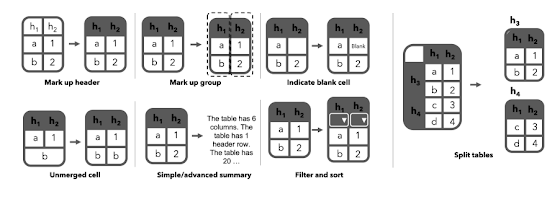
Figure 1: Based on the guidelines and the study, the authors built a browser plug-in to make the table more accessible. Tables are an excellent medium for sighted people to understand the data's structure and contents. They are popular in many online documents, including news articles, government reports, and online applications like bank statements. It uses many visual metaphors that sighted people can quickly notice. Those metaphors facilitate an understanding structure without explicitly explaining the complex system. But you can imagine how hard it would be for people with visual impairments who need to use a screen reader, which linearizes all this information. Imagine how confusing it would be when the user's cursor is on top of an empty cell. For example, the screen reader doesn't say anything. The user might think they didn't press the key or need instruction of guidelines to access the multilevel merge cell. Yanan Wang et al. recently published a paper on “ Wh...

2022-09-12: Summary of "Enabling Convenient Online Collaborative Writing for Low Vision Screen Magnifier Users"

Image
In the recent era, online document editors have become popular because online document editors can be shared with others and parallelly many people can edit that document. We can also see the history of those changes online. We can set various levels of access for online document editors, for example, we can give access to viewers, editors, or commenters.    Low-vision users use all these features by using screen readers. However, the excessive panning required to use these features is tedious for low-vision users. It is a very time-consuming task for low vision users, even for performing basic activities on online document editors. To see comments for any text or history of changes, users must scroll to the right and left end of the page. Once they scroll, they must remember the location of text. Figure 1 in Lee et al. In our paper "Enabling Convenient Online Collaborative Writing for Low Vision Screen Magnifier Users", we created a browser extension  that displays pop u...