Posts

Showing posts with the label Privacy

2026-04-11: PostGuard: The Hackathon-Winning AI That Stops Career-Ending Posts

Image
From March 23rd to the 31st, the  Computer Science Graduate Society (CSGS)  at   Old Dominion University  hosted their Spring 2026  Hackathon . The competition brought together teams across master's and PhD categories to tackle different research topics, mainly in artificial intelligence (AI). Our team, the Attention Bros ( Sandeep Kalari and Dominik Soós ), chose to compete in Track 6: Privacy-Preserving AI, alongside four other great teams in the PhD category. We are grateful to announce that we won first place in the PhD category with our project, PostGuard! This was a fast-paced challenge completed over a single week. Despite the time constraints, we successfully engineered a novel architecture that balances AI utility. In this blog post, we provide an overview of the problem we tackled, the Privacy Paradox and existing methods, our system architecture; and the mathematically proven findings that secured our victory. For more details, you can explo...
2023-05-31: Towards an Ethical Framework for Full-Text Search in Web Archives

Image
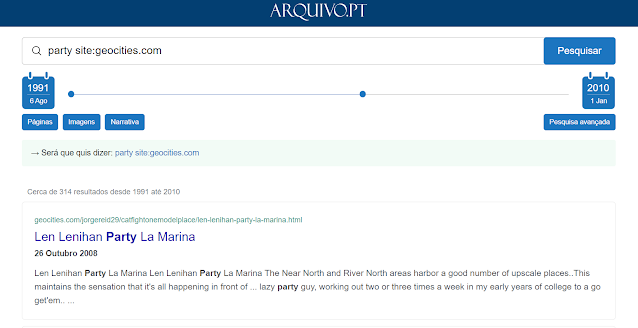
Figure 1: Arquivo.pt's full-text search engine makes it effortless to search archived content on GeoCities. The exploitative search results for the query " party site:geocities.com ", not included in the figure, show the dangers of full-text search without an ethical framework. On International Women's Day , I wanted to highlight how web archives have preserved progress towards gender equality. Both Archive-It and the UK Web Archive have dedicated collections about this topic.  Check out these women's rights web archive collection lists for #IWD2023 : @UKWebArchive women's rights collections: https://t.co/hfuik5pwDf Archive-It women's right collections: https://t.co/IUzAWZsdFF #WebArchiveWednesday — Lesley Frew (@lesley_elis) March 9, 2023 While the Internet Archive does not have any dedicated collections, it is possible to conduct a keyword/metadata search across the Wayback Machine holdings. I performed a Google search (Internet Archive Internatio...

2023-05-01: Summary of "Wearable Microphone Jamming"

Image
In " Wearable Microphone Jamming " ( CHI, 2020 ), Chen et al. explored and built a wearable device to disable surrounding microphones. Voice assistants like Alexa, Siri, and Google Assistant are widely used nowadays. Due to the increase in these voice assistants, a new security problem was also created. Since they can listen, record, and also save sensitive user data not only by using them. However, when they are used by surrounding users, is there any solution for these microphones' misuse? Chen et al. have come up with the idea of a bracelet that can disable its surrounding microphone by emitting ultrasonic noise. This ultrasonic noise is emitted randomly in the form of white noise in the range of 24 kHz to 26 kHz. This bracelet can disable or block hidden microphones in the wearer's surroundings, and it's based on the fact that when the microphone is exposed to ultrasonic noise then noise can leak into the audible range. Moreover, due to the natural hand moveme...

2016-06-27: Archives Unleashed 2.0 Web Archive Hackathon Trip Report

Image
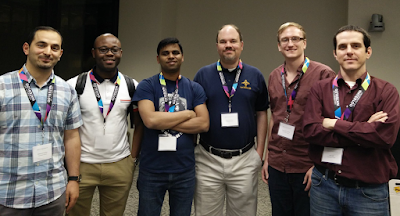
Members from WSDL who participated in the Hackathon 2.0 Last week, June 13-15, 2016, six members of Web Science and Digital Library group ( WSDL ) from Old Dominion University had the opportunity to attend the second Archives Unleashed 2.0 at the Library of Congress in Washington DC. This event is a follow-up to the Archives Unleashed ( Web Archive Hackathon 1.0 ) held in March 2015 at the University of Toronto Library, Toronto, Ontario Canada. We ( Mat Kelly , Alexander Nwala , John Berlin , Sawood Alam , Shawn Jones , and Mohamed Aturban ) met with other participants, from various countries, who have different backgrounds -- librarians, historians, computer scientists, etc. The main goal of this event is to build tools for web archives as well as to support this kind of ongoing community to have a common vision of how to access and extract data from web collections. This event was made possible with generous support from the National Science Foundation , the Social Science...