Posts

Showing posts from June, 2025

2025-06-27: Paper Summary: MemoRAG: Moving towards Next-Gen RAG Via Memory-Inspired Knowledge Discovery
Image
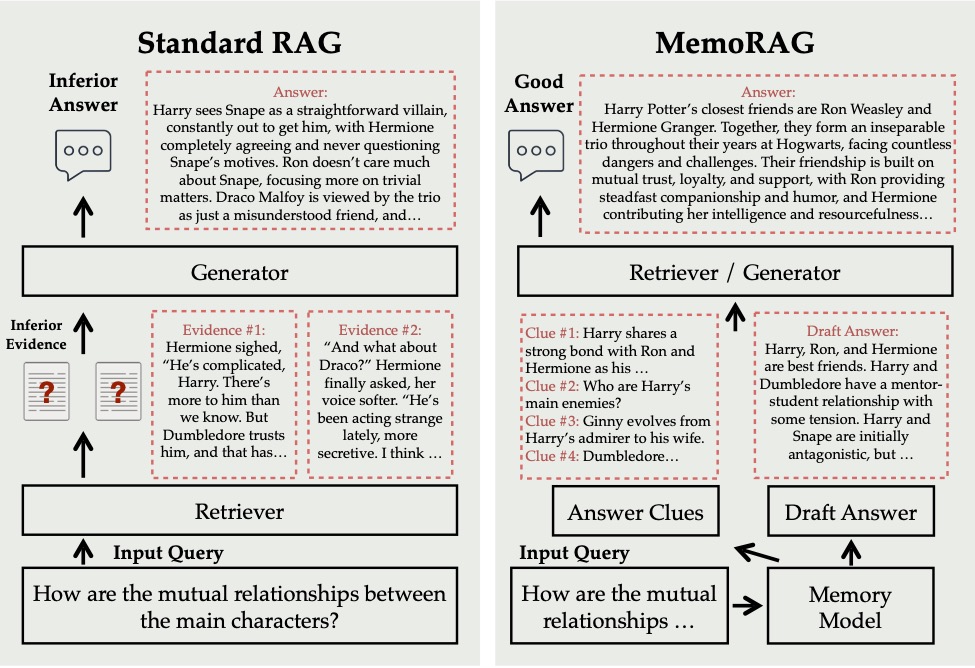
  Comparison of Standard RAG systems and MemoRAG ( Qian et al. ) In my post “ ALICE - AI Leveraged Information Capture and Exploration ” , I proposed a system that unifies a Large Language Model (LLM) with a knowledge graph (KG) to archive routinely lost information from literature generating events. While assessing project risks, we have further researched hallucination and semantic sprawl mitigation strategies. I have been focusing on representation learning and embedding space methods to reduce the need for external knowledge bases such as in Retrieval Augmented Generation (RAG) methods. Along the way, I discovered similar current research. In this post, we review “ MemoRAG: Moving towards Next-Gen RAG Via Memory-Inspired Knowledge Discovery ”, a novel approach to RAG by Hongjin Qian, Peitian Zhang, and Zheng Liu from the Beijing Academy of Artificial Intelligence; and Kelong Mao and Zhicheng Dou from Renmin University of China published in the ACM Web Conference 2025 . MemoRAG...

2025-06-24: GPU Hours Granted on Hypothesis Generation by Oak Ridge Leadership Computing Facility

In collaboration with Oak Ridge National Laboratory, the LAMP-SYS Lab was granted 20,000 node hours on the Frontier supercomputer cluster and 2500 node hours on the Andes supercomputer cluster. This joint proposal is a collaboration with Dr. Tirthankar Ghosal , a scientist at the Advanced AI Methods at Scale (AAIMS) group in the National Center for Computational Sciences , Oak Ridge National Laboratory , my student Dominik Soós , and me.  The goal of this proposal is to investigate the feasibility of generating hypotheses through interactions between expert LLMs and then ranking hypothesis candidates by Z-scores , a novelty metric developed by Dr. Uzzi .  The project will advance hypothesis generation by improving the hypothesis novelty in the candidate generation phase and the candidate selection phase. The introduction of Z-scores provides a more scalable way to automatically evaluate novelty. The multi-agent LLMs will have the potential to mitigate the consistent mi...